8 Places in a Home People Almost Never Clean

A woman uses an extendable duster to clean a hanging pendant light in a modern, neutral-toned living room.

A meticulously curated home loses its luster when invisible dust settles into neglected architectural corners. Elevating your living space requires looking beyond surface styling to uncover the overlooked cleaning spots that dull high-end finishes.

Modern interior design celebrates complex textures, custom millwork, and layered lighting schemes. Unfortunately, these sophisticated design trends also create unexpected sanctuaries for hidden dirt in your home that routine maintenance rarely reaches.

Integrating these eight overlooked zones into your seasonal routine preserves your investment and restores visual clarity. Here is your definitive spring cleaning guide to revitalizing the architectural elements people forget to clean.


Cutaway illustration of a tiered pendant light fixture being dusted with a feather duster.
Dust particles settle continuously onto canopies, hanging textile cords, and delicate glass diffusers of statement ceiling fixtures.

Trend #1: Sculptural Lighting and Statement Pendants

The shift toward oversized statement pendants and organic plaster chandeliers defines contemporary residential design. Homeowners install sculptural ceiling fixtures as dramatic artistic focal points in dining rooms and grand foyers.

Despite their visual prominence, ceiling fixtures remain prominent places people forget to clean. Dust particles settle continuously onto the upper surfaces of canopies, hanging textile cords, and delicate glass diffusers.

Designers prioritize atmospheric mood lighting over harsh overhead grids to achieve a sense of quiet luxury. However, a thin film of airborne grime can reduce fixture lumen efficiency by thirty percent over twelve months.

To restore luminous clarity, turn off the wall switch and allow bulbs to cool completely before dusting. Use an extendable electrostatic microfiber duster to lift loose debris without scratching artisanal hand-blown glass.

Heat emitted by incandescent and halogen bulbs bakes settling dust onto glass envelopes, creating a stubborn baked-on film. Regular wipe-downs prevent this heat-induced discoloration and keep lighting fixtures operating efficiently.

For brushed brass or patinated bronze components, wipe gently using a cloth barely dampened with distilled water. Avoid commercial ammonia sprays; they dissolve protective lacquers and permanently discolor living metal finishes.

Wipe the ceiling canopy and descending cords where household grease and airborne lint inevitably bind. Pristine lighting refines your ambiance and showcases the true color rendition of your curated furnishings.

Diagram showing wood slat wall construction, cleaning recommendations, and a magnified view of baseboard dust accumulation.
These vertical channels create hundreds of tiny linear ledges where ambient particulate matter silently settles between the slats.

Trend #2: Fluted Wall Paneling and Architectural Slatting

Wood slat accent walls and fluted tambour paneling have become hallmarks of modern architectural depth. Designers use vertical white oak and walnut ribs to infuse minimalist rooms with organic warmth and acoustic dampening.

These vertical channels create hundreds of tiny linear ledges where ambient particulate matter silently settles. Traditional horizontal dusting techniques simply skip across the surface, leaving hidden dirt in your home trapped within the grooves.

Biophilic design principles connect indoor spaces to the natural world through unvarnished timber and rich grain patterns. When dust gathers between timber slats, it leaches natural wood oils and leaves the finish looking parched.

Vacuum each vertical channel using a soft horsehair brush attachment to prevent scratching custom stains. Work methodically from the ceiling line downward to capture falling particles efficiently.

Follow by wiping the grooves with an antistatic microfiber cloth lightly misted with pH-neutral wood soap. Never spray liquids directly into fluted joints, as excess moisture swells engineered composite backings.

Pay special attention to the base where vertical wood slats meet horizontal flooring or baseboards. Pet hair and floor lint gather in these tight inside corners, requiring detail vacuum crevice tools to dislodge.

Maintaining indoor relative humidity between forty and fifty percent prevents airborne dust from clinging stubbornly to finished wood. Regular maintenance ensures your architectural feature walls retain their rich three-dimensional shadow lines.

A gloved hand cleans a black matte cabinet drawer with a gray microfiber cloth around a textured brass knurled handle.
Contrary to popular belief, intricate knurling ranks among the most frustrating overlooked cleaning spots in culinary spaces.

Trend #3: Matte Cabinetry and Tactile Knurled Hardware

Ultra-matte cabinetry paired with diamond-cut knurled hardware represents a sophisticated movement in bespoke kitchen design. Homeowners gravitate toward velvety, light-absorbing millwork contrasted against tactile, solid brass cabinet pulls.

Intricate knurling and lower cabinet reveals rank among the most frustrating overlooked cleaning spots in culinary spaces. Natural skin oils, cooking vapors, and dead skin cells accumulate within the microscopic diamond patterns of textured handles.

The prevailing ethos of quiet luxury demands understated materials that deliver subtle sensory delight upon touch. However, grimy hardware compromises this sensory experience and harbors stubborn kitchen bacteria.

Clean textured metal handles using a soft-bristled baby toothbrush dipped in warm, soapy water. Work the bristles into the knurling using small circular motions to lift compacted grime without scratching electroplated metal.

For matte cabinetry, wipe the horizontal upper door bevels where airborne grease binds with settling dust. Use a microfiber cloth saturated with diluted castile soap, followed immediately by a lint-free dry cloth.

Do not overlook the cabinet hinges and dampener pistons concealed within door reveals. Culinary grease coats these mechanical components, attracting dust that degrades soft-close functionality over time.

Consistent detailing protects matte finishes from unseemly burnishing and preserves the sharp tactile distinction of luxury hardware. Clean pulls create an immediate impression of immaculate luxury whenever anyone opens a drawer.

Close-up of a dusty black baseboard along light hardwood floors with a cleaning brush and cloth nearby.
Accumulated dust blunts the crisp boundary between walls and millwork, dulling satin paint sheens over time.

Trend #4: Architectural Baseboards and High-Contrast Trim

Interior designers increasingly reject minimalist flush reveals in favor of tall architectural baseboards and expressive picture rails. Saturated, high-contrast trim colors anchor living spaces and frame hardwood floors with dramatic historical elegance.

While vacuuming cleans floor surfaces, horizontal trim profiles remain prominent places people forget to clean. The upper ledge of seven-inch baseboards collects a steady layer of textile fibers, pet dander, and household dust.

Accumulated dust blunts the crisp boundary between walls and millwork, dulling satin paint sheens over time. Routine foot traffic and aggressive cleaning can then grind this loose debris into baseboard corner seams.

Integrate horizontal trim into your deep cleaning checklist using a specialized vacuum crevice tool. Wrap the nozzle edge with painter’s tape to prevent dark plastic scuffs on light-colored enamel paint.

Wipe the top molding profile with a warm water solution containing a few drops of vegetable-based surfactant. Dry the wood trim immediately to prevent moisture from penetrating mitered joints and causing seam separation.

Extend this targeted care to architectural chair rails and picture moldings mounted higher up the wall. These horizontal ledges trap airborne particulate that cascades down onto furnishings when disturbed by indoor drafts.

Crisp, gleaming baseboards accentuate the provenance of traditional millwork and showcase your flooring with gallery-level precision. This high-contrast definition establishes clean architectural sightlines across every hallway and foyer.

A woman sits cross-legged on a rug while vacuuming a curved white bouclé sofa with an upholstery attachment.
Vacuum the hidden junctions and woven textile valleys of curved seating to remove concealed debris, lint, and settled allergens.

Trend #5: Textured Bouclé Upholstery and Curved Furniture

Sculptural furniture upholstered in tactile bouclé, ribbed corduroy, and wool plush anchors modern living room trends. These organic silhouettes provide inviting physical comfort and create a serene, cocoon-like atmosphere throughout your home.

The looped yarns of textured fabric and hidden junctions of curved seating easily conceal significant amounts of debris. Microscopic allergens, lint, and street dust settle deep within the woven textile valleys and beneath seat cushions.

Modern residential design celebrates raw, textural surfaces over slick synthetic coverings. Unfortunately, heavily textured weaves trap ambient dust that can cause fabric fibers to degrade through continuous microscopic friction.

Maintain textural seating using a vacuum equipped with a high-efficiency particulate air filter and a specialized upholstery tool. Move the vacuum attachment slowly along overlapping paths to draw out deeply embedded particulate matter.

Remove loose seat cushions to inspect the underlying platform deck and internal dust covers. Heavy grit filters through textured fabric weaves, settling onto inner decking where it can harbor hidden allergens.

Never scrub looped bouclé vigorously when cleaning spots; excessive rubbing unravels yarn loops and creates unsightly fuzzy patches. Blot spills immediately using a clean, dry white cloth before applying an enzyme-based fabric cleaner.

Vacuum deep within curved backrest seams where dirt hides out of view. Thorough extraction protects your upholstery investments and keeps your bespoke seating fresh and tactile.

Illustration of a hand using a feather duster below three arched wall niches holding pottery, books, and decor.
Precarious open display shelves easily collect thick layers of dust around delicate pottery, books, and artwork.

Trend #6: Open Display Shelving and Curated Art Vignettes

Asymmetrical floating marble shelves and curated picture rails have largely replaced closed storage in contemporary living spaces. Homeowners style these open surfaces with collected stoneware, vintage ceramic vessels, and framed canvas art.

These open displays remain major overlooked cleaning spots because dusting around delicate arrangements feels precarious. Consequently, the top edges of artwork, hollow pottery interiors, and decorative book pages collect thick layers of dust.

Curated vignettes reflect personal narrative and artistic taste, but dingy accessories undermine your overall room styling. Airborne particles also discolor unsealed pottery and deteriorate antique paper goods over prolonged exposure.

Empty display shelves completely during seasonal cleaning rather than wiping loosely around your prized treasures. Clean the top edges of framed art with a dense microfiber duster to capture dust without scratching frames.

Avoid using feather dusters on fine art frames, as stiff quills can chip gilded finishes or scratch delicate acrylic glazing. Soft, high-density split microfiber cloths trap floating particles securely without requiring aggressive surface pressure.

Use a micro-attachment vacuum kit to lift debris from inside decorative urns and across book leaf edges. Clean protective glass with an ammonia-free optical spray applied directly onto a microfiber cloth, never onto the frame.

Restyling your immaculate objects against freshly wiped marble or timber shelves brings crisp visual rhythm to your living room. Dust-free surfaces reflect natural light evenly, highlighting subtle glazes and organic stone veins.

A woman wipes down a dark stone countertop along the edge of an undermount sink using a blue cloth.
Moisture, food splatters, and dish soap residue gather in the dark silicone recess beneath undermount kitchen sinks.

Trend #7: Undermount Sinks and Seamless Stone Countertops

Seamless stone countertops and undermount kitchen sinks dominate luxury kitchen design, providing uninterrupted horizontal expanses. Eliminating the raised metal sink rim creates an uncluttered silhouette that simplifies daily countertop wipe-downs.

However, the hidden underside perimeter where the countertop overhang meets the sink lip harbors alarming contamination. Moisture, food splatters, and dish soap residue gather in this dark silicone recess, encouraging black mold growth.

Modern kitchens function as both culinary workspaces and refined gathering hubs for entertaining guests. Overlooking this hidden joint can compromise food preparation safety and eventually degrade the structural silicone seal.

Inspect this concealed seam by shining an inspection flashlight upward from inside the sink bowl. Apply a foaming oxygen-based bleach cleaner directly into the underside crevice to sanitize microbial growth safely.

Scrub the narrow joint using an angled detail cleaning brush to dislodge built-up biofilm and trapped grime. Rinse the joint thoroughly with hot water and dry the silicone seam with a dedicated microfiber cloth.

Extend your cleaning reach to the removable rubber splash guard inside the garbage disposal collar. The underside ribs of this flexible gasket accumulate decomposed organic residue that generates unpleasant odors throughout the kitchen.

Always verify cleaner compatibility with your countertop material; never apply acidic solutions to marble, limestone, or soapstone. Preserving this structural joint maintains kitchen hygiene and protects your stone investment.

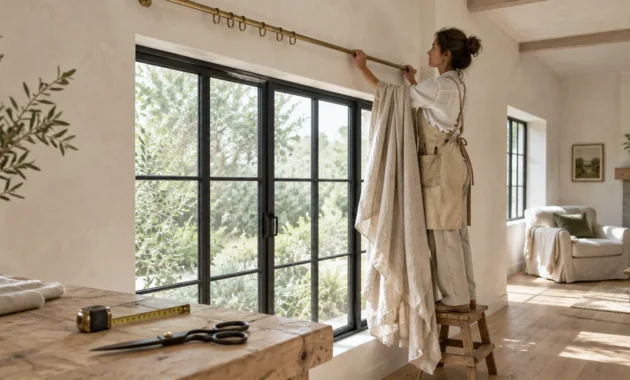
High-angle view from a ladder of a dusty curtain track holding beige drapery next to a window.
Drapery panels act as giant air filters, trapping particulate matter circulating through home heating and cooling systems.

Trend #8: Floor-to-Ceiling Drapery and Recessed Tracks

Floor-to-ceiling drapery panels suspended from concealed architectural ceiling tracks expand vertical scale and introduce soft theatricality. Designers specify generous widths of Belgian linen and sheer wool to soften harsh acoustic reflections in modern rooms.

The upper pinch pleats of tall draperies and hidden ceiling recesses represent prominent places people forget to clean. Drapery panels act as giant air filters, trapping particulate matter circulating through your home heating and cooling systems.

Concealing drapery hardware within dropped ceiling pockets produces seamless minimalist lines between wall surfaces and ceilings. Unfortunately, these hidden ceiling channels accumulate lint and cobwebs that eventually jam the gliding carrier mechanisms.

Vacuum ceiling tracks twice a year using an extendable vacuum wand fitted with a soft dusting brush. Clear debris from the glides before applying a dry PTFE lubricant to ensure silent, effortless operation.

Vacuum drapery fabric from top to bottom using reduced suction to prevent pulling delicate natural fibers. Treat heavy linen panels with a vertical garment steamer to release settled odors and smooth seasonal creases.

Examine the bottom hem where pooling draperies kiss hardwood or stone flooring. This pooling fabric sweeps up floor dust continuously, requiring gentle weekly vacuuming to prevent permanent hemline discoloration.

Restoring your drapery fabric revives indoor air freshness and ensures your luxurious window treatments cascade with effortless architectural elegance. Clean textiles maintain their structural drape without collecting unsightly static cling.

Architectural cutaway sketch of a modern home interior with dotted golden arrows tracking high walls, beams, and baseboards.
Integrating neglected cleaning zones into routine care safeguards your health while showcasing your design investments at their absolute best.

The Big Picture: Weaving These Trends into Your Home

Elevating your interior spaces requires harmonizing forward-thinking aesthetics with diligent spatial stewardship. Integrating neglected cleaning zones into your lifestyle safeguards your health while showcasing your design investments at their absolute best.

Rather than tackling your entire residence in one exhausting weekend, organize your spring cleaning guide by material category. Dedicating focused sessions to raw timber, delicate metals, or custom upholstery ensures appropriate care for every finish.

Invest in quality maintenance tools like horsehair attachments, electrostatic dusters, and pH-neutral formulas to protect bespoke surfaces. Professional tools prevent the surface micro-abrasions that prematurely age high-end finishes and dull architectural luster.

Quiet luxury is as much about cleanliness and maintenance as it is about bespoke furniture and curated art. When you eliminate hidden dirt in your home, natural light bounces freely, revealing the true brilliance of your decor.

Transforming seasonal deep cleaning into an architectural ritual safeguards your home’s aesthetic integrity and physical materials. Thoughtful maintenance honors the craftsmanship of your home, ensuring your design vision remains perpetually captivating.

For the latest color forecasts, consult industry leaders like Pantone and paint companies like Benjamin Moore. For professional design standards, refer to the American Society of Interior Designers (ASID).

Disclaimer: This article reflects design trend analysis and predictions. Personal taste and timeless design principles should always guide your decorating choices.

Frequently Asked Questions

How often should you deep clean architectural lighting and ceiling details?

You should clean high-level architectural lighting and ceiling fixtures at least twice each year. Scheduling this maintenance during seasonal daylight saving transitions prevents heavy dust layers from reducing overall illumination output.

Homes with long-haired pets or forced-air heating systems often require quarterly cleaning to keep artisanal glass and fabrics gleaming.

What is the safest way to clean natural stone edges without etching?

Always clean natural stone profiles and undermount sink joins using pH-neutral detergents formulated specifically for stone surfaces. Common acidic cleaners like white vinegar or citrus sprays will quickly etch delicate marble, limestone, and travertine.

Use a soft nylon brush to dislodge hidden mold, and dry the joint thoroughly with a plush microfiber towel.

Can frequent vacuuming damage delicate bouclé and textured upholstery fabrics?

Gentle vacuuming protects bouclé fabrics by extracting abrasive grit before it wears down underlying structural fibers. Always use a dedicated upholstery tool with reduced suction to preserve the textile’s dimensional loops.

Avoid rotating brush attachments or aggressive scrubbing, which cause fiber fuzzing and unsightly permanent fabric pilling.

How do hidden dust deposits affect indoor air quality and home aesthetics?

Overlooked dust pockets circulate fine allergens continuously through your HVAC system, degrading residential air quality and wellness. Visually, settling particulate matter dulls natural light reflection across matte paint finishes and architectural surfaces.

Targeting neglected zones maintains the crisp contrast and refined atmosphere that define professional interior design.

Get Weekly Decor Inspiration

Room ideas, styling notes and seasonal projects from our editorial team — one email a week, no noise.